Moulton Parish Church

St Peter and St Paul, Moulton, Northants
Moulton Bellringers
Introduction
Hello! My name is William Carter. I am the Tower Captain here at Moulton Parish Church. I am proud to lead a brilliant band of bell ringers, a band that has kept up a historic British activity and tradition in Moulton for hundreds of years. Please read on to learn more about the history of Bellringing in Moulton, as well as how you can get involved! Contact me: willcart3r@gmail.com
What is Bellringing?
For centuries church bells have sounded, calling people to worship, in celebration of special occasions, in remembrance, and to mark special events. The origins of what we call change ringing lie in the sixteenth century when church bells began to be hung with a full wheel, enabling the bell to swing in a full circle and back again. This gave ringers control of their bell, which allowed sets of bells (rings) to be rung in a continuously changing pattern. Music is created by moving bells up and down the ringing order to a defined sequence known as a method. Bellringing is a team activity that stimulates the brain and helps keep you fit… it also makes a glorious sound! Many consider ringing to be their contribution to church life, others do it for the pure pleasure it brings.


A Brief History of Moulton Church and its Bells
The first church at Moulton (c. 525–925) had no bells; parishioners were called by striking pieces of ‘sacred board’ together. This church was burned down. Saxons built a stone church (c. 925–1017) and might have had a small bell in the west wall of the tower, along with the usual ‘lytel hande belle’ but this was destroyed in further Viking raids. Around 1225, the present stone building was begun, and the lower stage of the tower was completed, and bells – including a Tenor Bell newly cast with the head of King Henry III, one of the few 13th-century bells of its kind in England, were hung in the tower.
By c.1425, the upper belfry and spire were added, and all bells were relocated there. Between 1450 and 1550, more bells were added, including a 'Mote-Bell', a great bell used for town and court purposes. A change-ringing course for four bells (Plain Bob Minimus), carved into the wood of the tower, likely dates from around 1600; it was discovered in 1885 during the restoration of the church. It is claimed that during the Civil War (~1645), Cromwell’s Parliamentary army wrecked the lead covered spire to make musket shot, broke the stained-glass windows, and damaged all the bells to some extent. By 1795, fears over the safety of the bells led to all five being recast by Edward Arnold of Leicester into a ring of six, with a Tenor of 17 cwt in F (later discovered to actually weigh 16cwt) with beautiful ornamental designs on both Tenor and Treble.
By 1883, the tower was again in poor condition, so local repairs were made by Taylor & Co. in 1884. In 1934 a new steel frame was erected in the lower part of the tower, and two new bells were added in memory of the illustrious William Carey: one gifted by Sidney Madge – a Moulton historian – the other by local subscription. Between 1973 and 1974, Taylor & Co. remodelled the octave into a lighter, more tuneful ring of ten – retaining three 1795 bells and the two Carey bells, and casting five new ones. Two further bells were added in 1993, paid for by a generous donation from William K Walden in memory of his parents, completing a remarkable set of 12 – one of only about 150 in England. The 11th bell was recast in 1999 after it cracked during a bellringing practice. ‘Moulton Church before the Civil War’ -
Barry Care and Sam King (various sources)

Social
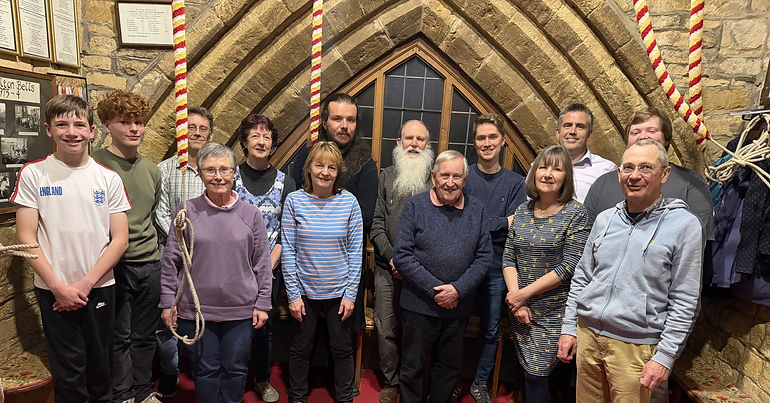
Not only do we get together to enjoy our ringing, but we are a great group of friends outside of the belfry! After practice, we often enjoy a quick beverage just down the road at The Artichoke Inn, we also organise a Summer BBQ, as well as a Christmas meal to bring our families together twice a year. We believe that socialising outside of the belfry fosters a great community spirit which reflects in our communication and teamwork when we ring.
Barry and Mollie Care
We are lucky people having reached an age where we are able to look back over 70 years as bellringers at Moulton Parish Church and the fun, fellowship, and company of so many ringers during that time. We began our ringing whilst teenagers, as did many of our young friends at that time, fascinated by its intricacy, demands on our skills, and the long history of Moulton bells.

We are reassured young people still continue to find enjoyment in the same way and so ensuring this wonderful tradition continues. The loyalty of our ringers ensures Moulton Bells sound out over our community to mark important occasions and national events from time to time, as well as reminding everyone their Church remains for them at the heart of our village life.
Pat O’Connor
I was introduced to bellringing by my Grandad at Sywell Parish Church when I was a teenager - learning on just 3 bells! Over forty years later, I came back to bellringing at Moulton Church - a tower with 12 bells! This means I now have been introduced to learning various methods, the memory of which I find very challenging at times - 3 bells were so much easier! I really enjoy the friends I have met through bellringing, BBQs attended and meals eaten together. My main aim though has always been to ring at the services and to invite people to Church - without too many mistakes!


Neil White
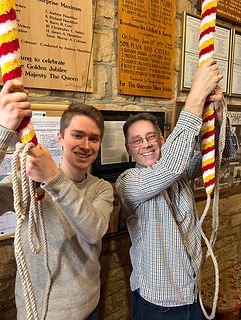
It always catches people by surprise when I mention to them that one of my hobbies is bell ringing. Not only do I attend practices on a Monday night but I also ring on a Sunday morning before the service, so twice a week I am in the tower of Moulton Parish Church pulling ropes to create a very English sound. I became interested in this very old tradition when walking to the church and hearing the bells, apparently one of the most popular sounds of Britain alongside birdsong. A climb up the steps into the ringing room and meeting the pleasant band of ringers led to a natural wish to at least give it a go. And so, three years later and alongside my youngest son, I now ring bells myself and help to create the sound I had heard in the first place. It is a world of constantly trying to improve my technique, to learn new ‘methods’ and to play a part in Moulton village life in a slightly unusual way. It isn’t physically demanding, but it can be challenging to do several things at once: pulling the rope correctly, remembering who you need to ring after and timing it right. It all comes with practice, and improving is very rewarding
William Carter - Tower Captain
Coming from a family of bellringers and teachers, perhaps it was written in my DNA (or at least my destiny) that I would become a bellringer and eventually Tower Captain at Moulton; responsible for running sessions, teaching learners, and maintaining the bells. I began my bellringing journey mere weeks after I was born; sitting in the corner of the ringing room for more or less 10 years straight until I was big enough to learn to ring. Bellringing is a hobby very dear to me, I get to spend valuable time with my family and friends, sharing something we are all passionate about. Teaching learners and developing our band's ability is something I’m immensely proud of, seeing improvements in people’s skill is incredibly fulfilling, as are the other elements of this role and hobby.

Contact
Have you ever looked up at a tower, enjoying the music of the bells, either in Moulton or elsewhere, and thought, ‘I wonder how that works?’ or ‘I’d love to have a go at that someday’, well - why not get in touch and learn firsthand! We are a friendly group of ringers who love to talk about our shared passion. Whether you’d like to have a go, or just see how it’s done, anybody is welcome to visit us on a Monday night from 19:30-21:00. Please contact me on the following email for more information about our practices, or to let me know that you’ll be attending. willcart3r@gmail.com